

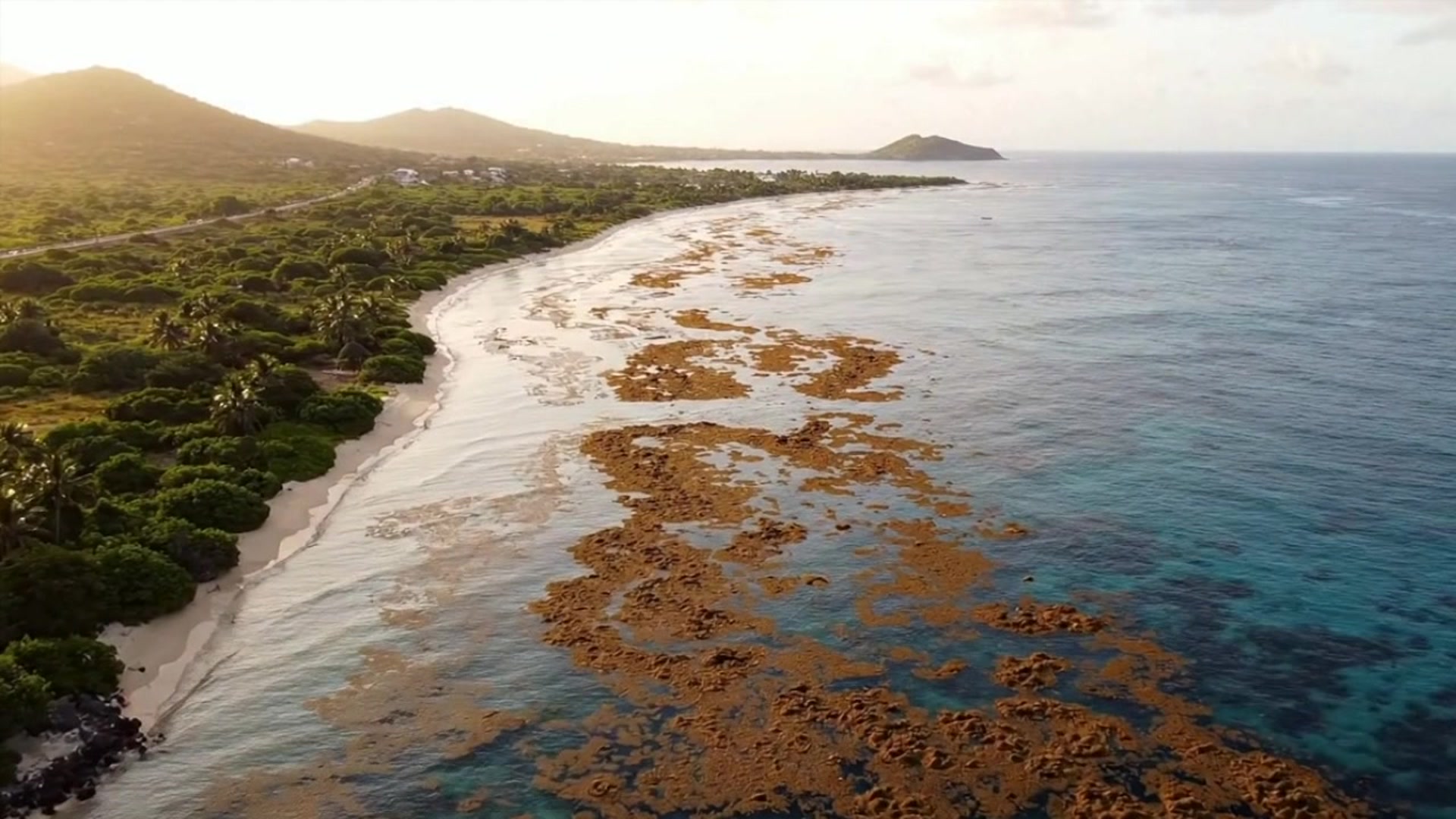
Turning sargassum into drop-in fuel.
Salacia transforms marine biomass into renewable fuels and low-impact materials - compatible with the engines, networks and industries today’s economy already runs on.
Building the future where economic growth and sustainability are compatible.
A coastal burden measured in millions of tonnes.
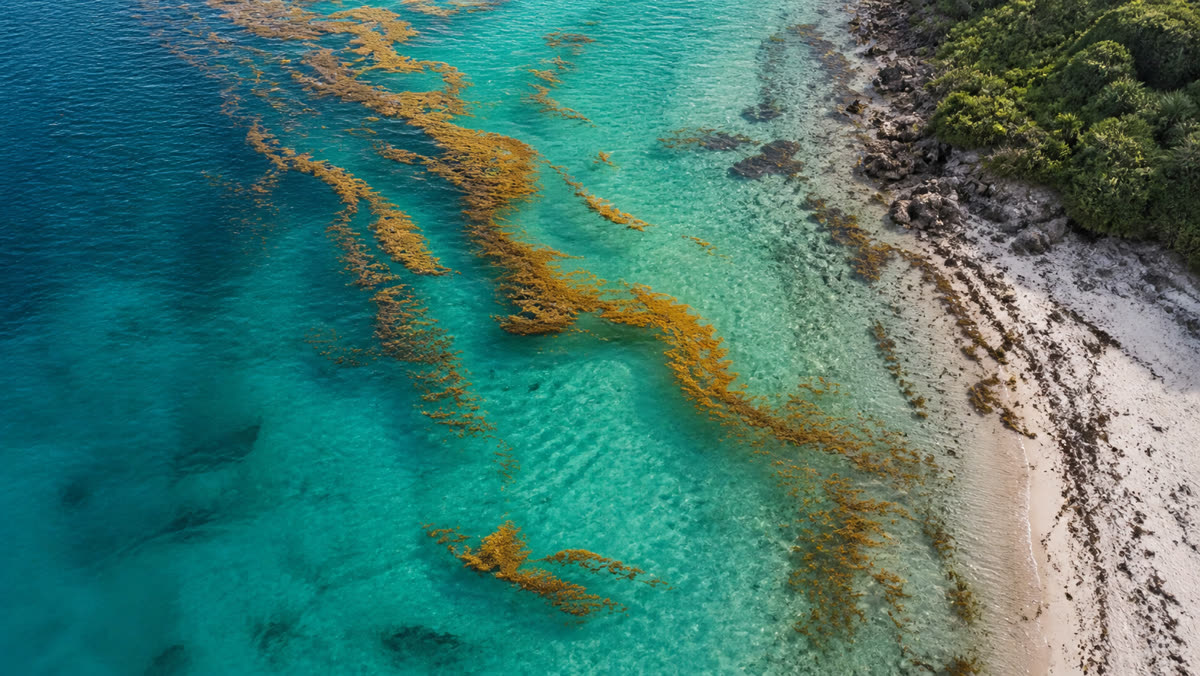
Every year, sargassum strands on Caribbean and West African coasts - smothering beaches, releasing hydrogen sulphide as it rots, and forcing costly clean-ups. Today it is treated as waste. It is, in fact, an under-used feedstock at industrial scale.
- of sargassum in the Atlantic belt at the July 2025 peak
- 38 Mt
- of arable land required
- 0 ha
- lower lifecycle emissions
- ~78%
- SAF demand by 2030
- 9×
Sargassum tonnage: University of South Florida Sargassum Outlook via NOAA, July 2025. Lifecycle figure: compared with fossil fuels; internal screening model, independent validation pending. SAF demand: IEA Renewables 2025, main case - from 1 billion litres in 2024 to 9 billion in 2030.
Read on: sargassum, the seaweed that became a coastal problem →
Show the figures
| Year | Observed annual peak (2011-2026) | Lower case: climate-stress sensitivity | Upper case: historical trend continues |
|---|---|---|---|
| 2011 | 1.8 | – | – |
| 2012 | 2.7 | – | – |
| 2013 | 0.1 | – | – |
| 2014 | 4.7 | – | – |
| 2015 | 11 | – | – |
| 2016 | 2 | – | – |
| 2017 | 6 | – | – |
| 2018 | 20.4 | – | – |
| 2019 | 10 | – | – |
| 2020 | 12.7 | – | – |
| 2021 | 18 | – | – |
| 2022 | 24.2 | – | – |
| 2023 | 13 | – | – |
| 2024 | 10.5 | – | – |
| 2025 | 38 | – | – |
| 2026 | 33.6 | 33.6 | 33.6 |
| 2027 | – | 33.2 | 35.5 |
| 2028 | – | 32.9 | 37.4 |
| 2029 | – | 32.5 | 39.4 |
| 2030 | – | 32.2 | 41.3 |
| 2031 | – | 31.8 | 43.2 |
| 2032 | – | 31.5 | 45.1 |
| 2033 | – | 31.1 | 47.1 |
| 2034 | – | 30.7 | 49 |
| 2035 | – | 30.4 | 50.9 |
| 2036 | – | 30 | 52.8 |
| 2037 | – | 29.7 | 54.7 |
| 2038 | – | 29.3 | 56.7 |
| 2039 | – | 28.9 | 58.6 |
| 2040 | – | 28.6 | 60.5 |
| 2041 | – | 28.2 | 62.4 |
| 2042 | – | 27.9 | 64.4 |
| 2043 | – | 27.5 | 66.3 |
| 2044 | – | 27.2 | 68.2 |
| 2045 | – | 26.8 | 70.1 |
| 2046 | – | 26.4 | 72 |
| 2047 | – | 26.1 | 74 |
| 2048 | – | 25.7 | 75.9 |
| 2049 | – | 25.4 | 77.8 |
| 2050 | – | 25 | 79.7 |
Beyond the limits of terrestrial biomass.
Conventional biomass faces structural constraints that limit its scalability. Marine biomass offers a fundamentally different resource base.
Terrestrial biomass
- Land use pressure
- Freshwater competition
- Food & feed conflict
- Agricultural constraints
- Scalability ceiling
Marine biomass
- No arable land required
- Vast marine resource base
- Coastal valorization potential
- Wet biomass compatible
- Circular industrial model
A fraction of what already washes ashore
One platform at full capacity valorises 0.4 million tonnes of wet sargassum a year - a sliver of the 2 to 10 million tonnes that models estimate strand on Atlantic and Caribbean coasts annually.
- 0.4 Mt · one platform, one year
- 2–10 Mt · modeled annual coastal strandings
From the shoreline to the fuel tank, in three steps.
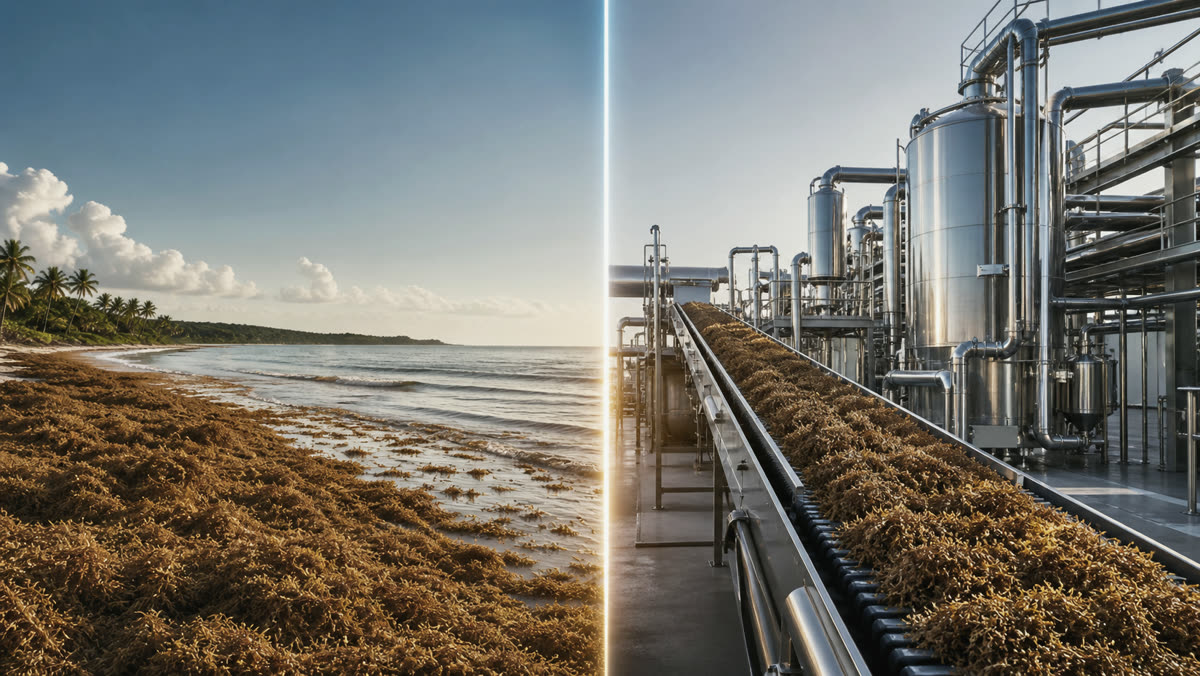
Wet macroalgae go in; liquid fuel precursors come out. No drying step, no arable land, no new distribution network.
- 01
Collection
Sargassum is collected at sea and on shore by coastal partners and conditioned for processing.
- 02
Thermochemical conversion
In Salacia's process, controlled temperature and pressure break the wet organic matter down into liquid fuel precursors, with no drying step.
- 03
Drop-in fuels
Salacia refines the liquid fractions toward diesel-like, marine and, in time, aviation fuels that existing engines already accept.
From coastal burden to industrial resource
Marine biomass stranding along tropical and subtropical coastlines is both an ecological challenge and a strategic opportunity. Salacia’s process begins where the problem is most visible - transforming what arrives on shore into a clean, scalable industrial feedstock.
Early-stage, and specific about it.
Salacia is at laboratory proof. Here is what is in place today - no more, no less.
- Roadmap Phase 1 of 6 - laboratory proof Integrated batch process chain, 2026–2027
- Research Mines Paris – PSL Thermochemical conversion, high-pressure processes, experimental validation
- Supply French Departments of the Americas Coastal collection partners; site of the first industrial demonstration
- Company Founded 2025 in France Engineer-led SAS, supported by Pépite PON
Working with


Recognition


From laboratory proof to industrial platform.
A phase-gated development plan, from the current laboratory stage to the first large-scale platform and beyond.
Latest from Salacia.
Salacia pitches at VivaTech 2026
Salacia presents its vision for turning marine biomass into a strategic renewable-energy resource.
Read more →Salacia establishes its strategic advisory board
Senior industrial, energy and sustainability expertise joins Salacia’s path toward scale.
Read more →Salacia exhibits at ChangeNOW 2026
Salacia presents its marine-biomass approach at one of the world’s leading impact and sustainability gatherings.
Read more →
Build the future of energy with us.
Whether you are an investor, industrial partner, institution, or journalist, we’d be glad to discuss how Salacia fits your strategy.
Contact us