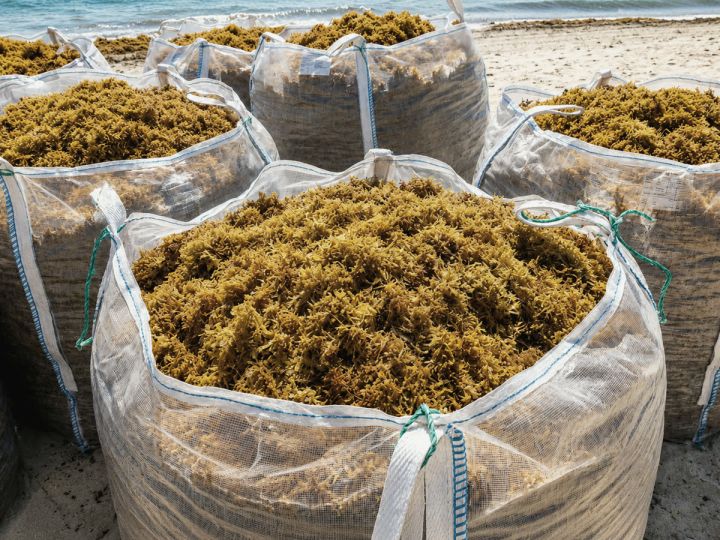
Salacia has partnered with Sargawatt to strengthen one of the most important foundations of its future industrial model: access to a reliable, traceable and scalable supply of marine biomass. The collaboration focuses particularly on sargassum, a marine resource whose recurring accumulation across Caribbean coastlines creates significant environmental, economic and logistical challenges for local territories.
For Salacia, developing technologies capable of transforming marine biomass into renewable fuels is only one part of the equation. Building a viable industrial value chain also requires a robust upstream system capable of collecting, preparing and supplying biomass with sufficient consistency, traceability and volume. The partnership with Sargawatt contributes directly to this objective by connecting expertise in sargassum collection and supply with Salacia’s work on marine-biomass conversion and renewable fuel production.
The collaboration is designed around a shared ambition: to move beyond the perception of stranded sargassum as a waste-management problem and instead develop the conditions for it to become a usable industrial resource. This means thinking about the entire chain - from coastal collection and logistics to biomass quality, preparation, transportation and ultimately industrial valorization.
A dependable feedstock strategy will be essential as Salacia progresses from laboratory development toward continuous pilot systems and, later, industrial deployment. The volumes required at each stage will increase substantially, making early work on the supply chain an important part of the company’s scale-up roadmap.
Traceability is equally important. Understanding where biomass comes from, how it has been collected and how it moves through the supply chain will support future requirements relating to operational performance, environmental assessment and the consistency of industrial processes. By working with specialized partners upstream, Salacia aims to build these considerations into its model from the beginning rather than treating biomass procurement as a separate challenge later in development.
The partnership also reflects Salacia’s broader approach to industrialization: the technology cannot be developed in isolation from the ecosystem that will ultimately supply and operate it. Collection operators, coastal territories, logistics providers, research institutions and future industrial partners will all play a role in creating a functioning marine-biomass value chain.
By bringing together complementary capabilities, Salacia and Sargawatt are helping lay the foundations for a system in which biomass collected in affected coastal regions can progressively be connected to higher-value industrial applications. The long-term objective is to contribute to a model that simultaneously supports coastal resilience, local resource valorization and the development of renewable fuel supply chains.
This partnership therefore represents more than a sourcing relationship. It is an early step toward structuring the upstream infrastructure required for Salacia’s future deployment and toward demonstrating how an environmental burden can become part of a productive, circular and locally anchored industrial ecosystem. Discover the partners contributing to Salacia’s development.